Miguel Del Valle

I am an economist with a Bachelor's and a Master's degree from Universidad de Chile. My research interests are spatial economics, production networks, and international trade.

I combine data built from administrative microdata, surveys, and international datasets with general equilibrium quantitative models.

My work focuses on understanding the aggregate and distributional consequences of productivity shocks, infrastructure investment, natural disasters, and other economic events. I use this evidence to inform policy design aimed at mitigating welfare losses and increasing welfare gains.

I plan to apply to PhD programs in Economics this year.

Working Papers

The Geographic and Sectoral Impact of Productivity
with Federico Huneeus Status: Revision requested at the Journal of International Economics

First-page preview of The Geographic and Sectoral Impact of Productivity
Abstract

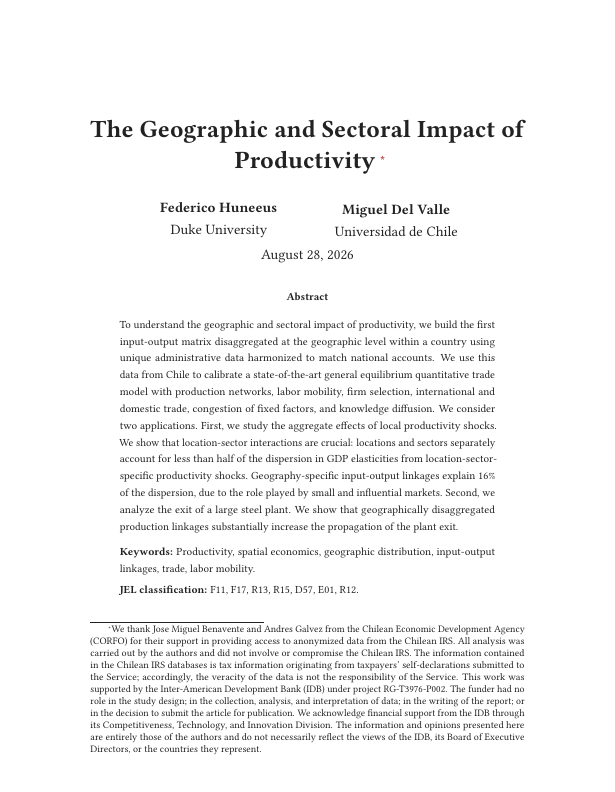
To understand the geographic and sectoral impact of productivity, we build the first input-output matrix disaggregated at the geographic level within a country using unique administrative data harmonized to match national accounts. We use this data from Chile to calibrate a state-of-the-art general equilibrium quantitative trade model with production networks, labor mobility, firm selection, international and domestic trade, congestion of fixed factors, and knowledge diffusion. We consider two applications. First, we study the aggregate effects of local productivity shocks. We show that location-sector interactions are crucial: locations and sectors separately account for less than half of the dispersion in GDP elasticities from location-sector-specific productivity shocks. Geography-specific input-output linkages explain 16% of the dispersion, due to the role played by small and influential markets. Second, we analyze the exit of a large steel plant. We show that geographically disaggregated production linkages substantially increase the propagation of the plant exit.

Keywords Productivity · Spatial Economics · Geographic Distribution · Input-Output Linkages · Trade · Labor Mobility

Work in Progress

Welfare Effects of Natural Disasters

Local exposure to natural disasters can be substantially more costly than aggregate uncertainty about warming trajectories. Understanding how these events affect both the places they strike and the national economy is therefore central to the public policy debate. We link administrative data on the universe of formal firms in Chile with records of natural disasters to estimate their impact on the economic activity of firms in directly affected locations. We then combine these elasticities with geographically and sectorally disaggregated economic accounts for Chile in a quantitative spatial general equilibrium model in which local shocks propagate across locations and sectors through domestic trade, input-output linkages, and labor mobility. The framework allows us to quantify the aggregate and distributional welfare effects of natural disasters, separating direct local losses from their propagation to the rest of the economy and identifying the locations and sectors that bear the largest costs.

Port Development in Networks

with Federico Huneeus

Ports are large, long-lived investments whose effects reach far beyond the regions where they are built, because they shape trade costs for the entire economy. We study the optimal size and location of ports in an interconnected economy. We use temporary port disruptions, together with vessel-tracking (AIS) data and customs records, to estimate how shippers substitute across ports and transport modes, the value of time in transit, and how congestion at terminals responds to traffic and installed capacity. We then combine these estimates with geographically and sectorally disaggregated economic accounts for Chile in a quantitative spatial general equilibrium model with production networks and labor mobility, in which trade costs arise endogenously from shippers' choices of transport mode and port. We use the model to evaluate how expanding or relocating port capacity reshapes trade costs, economic activity, and welfare across locations and sectors, and where additional capacity yields the largest gains.

The Geography of Industrial Policy

with Federico Huneeus

Industrial policy has returned to the center of the policy debate, yet its effects are usually measured only on the firms it supports. We study how the effects of industrial policy spread across firms, locations, and sectors, and how much of them reach the national economy. We use administrative data on Chilean firms, together with detailed administrative records on applications to the support programs of Chile's economic development agency, to estimate the effects of public support on the firms that receive it. We then combine these estimates with geographically and sectorally disaggregated economic accounts for Chile in a quantitative spatial general equilibrium model with a rich government sector, in which the effects on supported firms propagate through production networks and labor mobility. This lets us estimate the marginal value of public funds (MVPF) of these programs, accounting for general equilibrium spillovers and their fiscal effects, and identify where public support yields the largest returns.

References

Teaching

2023–2024

Teaching Assistant

Graduate · University of Chile

  • Macroeconomics II (×2), M.A. in Economics
  • Macroeconomics I (×2), M.A. in Economics
  • Econometrics I, M.A. in Economics
  • Statistical Analysis, M.A. in Public Policy

2020–2023

Coordinating Teaching Assistant

Undergraduate · University of Chile, Business and Economics

  • Statistics II
  • Behavioral Economics
  • Applied Economics
  • Introduction to Microeconomics (×4)

2019–2022

Teaching Assistant

Undergraduate · University of Chile, Business and Economics

  • Trade and Growth Theory
  • Labor Economics
  • Behavioral Economics
  • Introduction to Microeconomics
  • Statistics II (×4)
  • Statistical Theory (×2)
  • Statistics I (×3)
  • Mathematical Methods III (×2)
  • Introduction to Economics